Hope everyone has been enjoying the holidays!!
Part 1
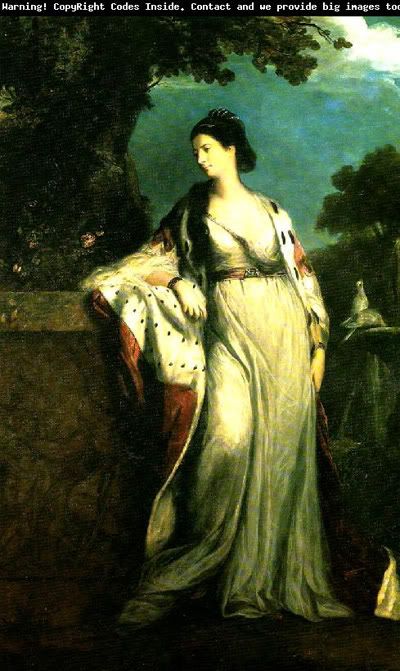
Reynolds did not always reference contemporary fashion so directly in his draped garments. His portrait of Elizabeth Hamilton, Duchess of Hamilton and Argyll from 1758-9 shows no sign of the contemporary silhouette given by the fashionable robe a la francaise. The silhouette given by the robe a la francaise is the one most traditionally associated with the eighteenth century. The skirt extends in a wide horizontal from the waist, the shape given by panniers. The back of the dress is draped in double box pleats which creates a flowing cascade of fabric, seamlessly connecting the top of the outer robe to the bottom, called a sack back or Watteau back, as Watteau painted numerous ladies wearing gowns with this feature. A robe a la francaise takes at least eight yards of fabric to make, not including the fabric needed for trimming and decoration, and thus was an enormously expensive item of clothing. To feature one in a portrait would not only show the stylishness of the sitter but also her wealth, especially if her gown was highly decorated.
But like the Duchess of Devonshire, the Duchess of Hamilton and Argyll chose a classical look instead, even taking it one step further and removing all references to contemporary fashion altogether. Even her hair is classicized, hanging around her body in luxurious tendrils as opposed to being swept back and styled in an arrangement of curls as was the contemporary fashion. The only nod to contemporary styles at all is the coronation kirtle loosely draped around her, signifying her as a duchess. By removing almost all references to contemporary fashion, the Duchess becomes a figure of classical antiquity, implying that, like the statues of antiquity still admired today, the Duchess will be admired centuries later as well. While fashions come and go, Ancient Greece and Rome seem to always be in style and held up as the pinnacle of great art and society. The Duchess chooses to associate herself with those ideals, as opposed to being seen as a figure from her own time, and thus becomes a timeless beauty like the Venus de Milo. Reynolds strengthens this connection to classical beauties like Venus, having the Duchess lean on a plinth decorated with the scene of the Judgment of Paris, as well as placing two white doves to the side of the painting, both references to the goddess of beauty.
Part 1

Reynolds did not always reference contemporary fashion so directly in his draped garments. His portrait of Elizabeth Hamilton, Duchess of Hamilton and Argyll from 1758-9 shows no sign of the contemporary silhouette given by the fashionable robe a la francaise. The silhouette given by the robe a la francaise is the one most traditionally associated with the eighteenth century. The skirt extends in a wide horizontal from the waist, the shape given by panniers. The back of the dress is draped in double box pleats which creates a flowing cascade of fabric, seamlessly connecting the top of the outer robe to the bottom, called a sack back or Watteau back, as Watteau painted numerous ladies wearing gowns with this feature. A robe a la francaise takes at least eight yards of fabric to make, not including the fabric needed for trimming and decoration, and thus was an enormously expensive item of clothing. To feature one in a portrait would not only show the stylishness of the sitter but also her wealth, especially if her gown was highly decorated.
But like the Duchess of Devonshire, the Duchess of Hamilton and Argyll chose a classical look instead, even taking it one step further and removing all references to contemporary fashion altogether. Even her hair is classicized, hanging around her body in luxurious tendrils as opposed to being swept back and styled in an arrangement of curls as was the contemporary fashion. The only nod to contemporary styles at all is the coronation kirtle loosely draped around her, signifying her as a duchess. By removing almost all references to contemporary fashion, the Duchess becomes a figure of classical antiquity, implying that, like the statues of antiquity still admired today, the Duchess will be admired centuries later as well. While fashions come and go, Ancient Greece and Rome seem to always be in style and held up as the pinnacle of great art and society. The Duchess chooses to associate herself with those ideals, as opposed to being seen as a figure from her own time, and thus becomes a timeless beauty like the Venus de Milo. Reynolds strengthens this connection to classical beauties like Venus, having the Duchess lean on a plinth decorated with the scene of the Judgment of Paris, as well as placing two white doves to the side of the painting, both references to the goddess of beauty.


 Posts
Posts

