Saturday, October 16, 2010

50 Followers!

A new post is coming soon, but I just want to take a second to celebrate getting fifty followers!! Thank you all so much for reading my blog, it makes me feel so special to know that people like what I do. I adore reading all of your comments and am thrilled to have such an intelligent little group of readers.

Love to you all!!

Wednesday, October 6, 2010

Historic Influence

Welcome to a new feature of The Fashion Historian! One of my favorite things to do, and one of my favorite research topics, is finding historic influences in modern haute couture. So every so often I'll put up a picture of couture next to a period image. No lengthy explanations about what the influence is or why it was chosen or the social relevance, I'll just let the images speak for themselves and let you enjoy some beautiful creations.
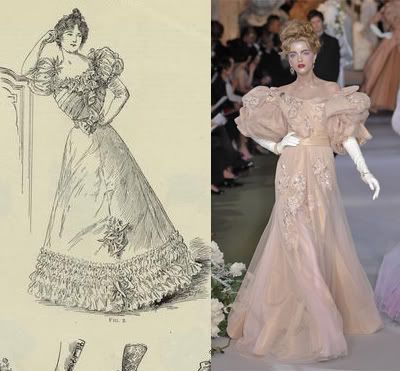
Photobucket
Left: Fashion plate from 1897, taken from the New York Public Library Digital Gallery.
Right: Dior Fall 2007 haute couture, designed by John Galliano.

My Own Research Part 2: How?

Back to blabbing about my own research! Previous posts on the topic:
Introduction
How: Monsieur Beaucaire (1924)

Earlier I covered one of the earliest 18th century films. Today I'll be talking about one of the most recent. The Duchess (2008) tells the story of fashion icon, top celebrity, and victim of a disastrous marriage Georgiana, Duchess of Devonshire. It starred Keira Knightley as the Duchess, Ralph Fiennes as her husband the Duke of Devonshire (and if I say so myself, this is the best performance in the entire film), and Hayley Atwell as the Duchess' best friend and the Duke's mistress Bess Foster. Costume Designer Michael O'Connor won a well deserved Oscar for his gorgeous creations, which were lauded both for their beauty and accuracy. This movie was visually stunning, however, there was one glaring inaccuracy.

Keira Knightley is a beautiful woman by our modern standards, but not by the standards of the 18th century. I think the best word to describe the ideal 18th century body is round. A round face, and a rounded figure that could be considered slightly plump by our modern standards. A body of this sort showed you were well fed, and having more fat on you meant a greater chance of surviving multiple childbirths. In addition, this love of roundness reflected the rococo aesthetic of sensuous curves and circles which dominated the century. The Duchess of Devonshire was known as a great beauty in her day, and while there are no images of her naked, based on this knowledge of ideal body type and the clothed images we do have, we can assume that her body followed this model.

Photobucket
Portrait by Gainsborough


Here we see the Duchess herself, in a portrait that caused a hat sensation (more on that later). Notice the roundness of her face, and the fullness of her arms and torso. Notice also how her clothing compliments the roundness of her figure, with her fichu (the sheer shawl wrapped around her shoulders) emphasizing the fullness of her bust, and her hedgehog hairstyle emphasizing the fullness of her face.

Contrast this image with one of Keira Knightley, who represents one of the modern ideals- the super stick thin woman.

Photobucket


This image is from Atonement (2007), which is set in the 1930s. But I chose it because it gives a great look of how slender Knightley is, and how this causes her bones to create angles. There is no way this woman would ever survive multiple childbirths in the 18th century.

Photobucket
Knightley in The Duchess


This image from The Duchess shows the sharp angles of Knightley's face. While this may be sought after today, it is practically the opposite of the soft roundness of the ideal 18th century woman. The fullness of her hair even seems to heighten the contrast given by the angles of her face. In addition, her wide lips are nothing like the small, puckered, cherub-like lips sought after in the 18th century.

Thus while Knightley may embody a 21st century ideal of attractiveness, she is no 18th century beauty. This is a pretty good representation of movies made post-studio system. Costumes are generally more accurate, hair and make up is still on a scale from accurate to not-even-close, but body type usually reflects a strictly modern ideal.

Why? Find out soon!